Why Some Stories Just Click
Two eye opening examples

Hi friend,
So great to see you! Pull up a chair and grab your favorite mug.
Hope you had a nice week.
You know how it is, you sometimes have the same thought popping into your mind in so many contexts, but you cannot put your finger on it or articulate it.
Where?
It’s the weirdest thing. It typically happens when I particularly like a restaurant dish, enjoy a clever clip on TikTok, watch a movie on Netflix, or meet an interesting person I clicked with.
What do you think is going on here?
The typical answer you’d think is that all these occurrences mirrored some elements in my inner personal narrative.
True!
But that’s selfishly looking at it from my perspective.
I’m speaking more about the actual source perspective.
The point of departure.
What makes that story, dish, or movie click to make it so appealing?
This goes back to two core terms in storytelling:
Story: a 3-act event or distinct element.
Narrative: A higher-level theme that ties all stories/events into a single meaningful idea or belief.
In brand storytelling, a good example is Patagonia’s brand narrative:
“We’re in the business to save the planet” to convey their commitment to climate change causes.
As such, all their campaign stories serve as proof points to the validity of this overarching narrative or theme.
The bigger truth here
This concept that escaped me is quite simple.
When you come across something that you especially like, often the reason you liked it boils down to:
That experience was narratively cohesive; every element felt intentional and connected to the larger narrative or theme.

Let’s look at 2 examples:
Food
The other night, we had dinner at Veganlitaly - a vegan Italian restaurant in Miami.
Why vegan? Because I’d say the burden of proof is heavier.
Innovation is not enough - it needs to be delicious.
I greatly enjoyed their Kale Caesar salad you see in the photo below.
Beyond the built-in novelty effect that is part of eating out and trying new dishes, the sweet and crunchy flavors were truly good.
This salad was made out of fresh kale, chickpea croutons, and chopped dates tossed in a house-made sweet agave dressing.
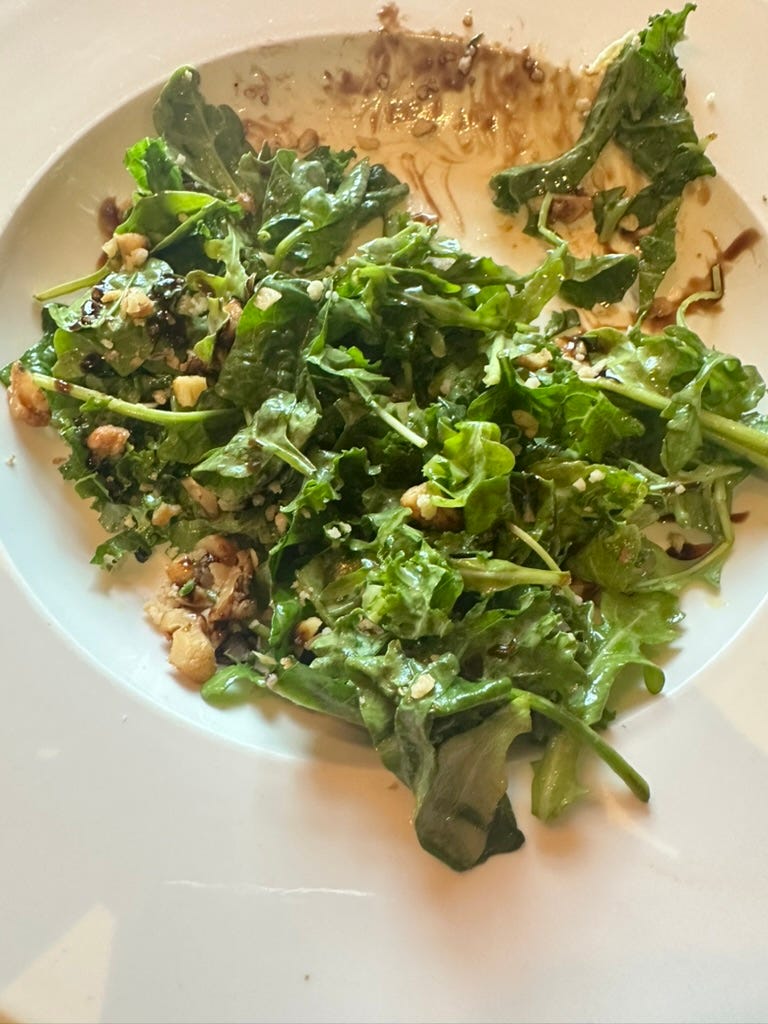
As you can see, there are not a whole lot of vegetables here. Ingredient diversity is low. No red tomatoes or carrots. It’s a green-based salad.
The principle of “Less is More” is key here.
The protagonist is obviously the Kale, and in supporting characters, you’ll find the chickpea croutons and chopped dates - tied together in a house-made sweet agave dressing.
This setup is what enables this intentional narrative cohesion.
Micro-drama
You’ve probably come across my recent micro-drama I started on Substack’s Notes.
So let me give you more context.
First off, in case you’re wondering, Micro-drama?
Read this:

It’s a story about Marea Labs - a fictional Miami startup building an AI sound-cancellation product called HUSHWAVE.
It can quiet motorbikes. Straight-piped loud cars. It can quiet car bass. It can quiet leaf blowers. Without any wearable device.
This is a concept I was always fantasizing about after experiencing all these annoyances, which I’m sure you often do, too.
But the team runs into a harder question: What should the technology refuse to erase?
To build a steady episode drip, each episode drop includes:
A few lines of story in Notes.
One cinematic image.
True, to the broader meaning of visual storytelling, with these two visual cues, I hope they’ll trigger a richer video play in readers’ minds.
The larger narrative here says this.
AI can do wonders - in this case, cancelling any noise, but what noises should the technology refuse to erase?
How do you apply human judgment effectively and still innovate?
The protagonist is the HUSHWAVE technology. And in supporting roles, you’ll find the Miami location and the startup employees who come across a bunch of challenges.

Design-wise, all the episodes, including this promo poster, reflect a bright turquoise neon color against a dark background palette.
Turquoise is typically associated with Miami and the Florida Keys.

In addition to the visual palette that ties it all together (i.e., “the house-made sweet agave dressing”), I also created the show’s theme song, “Don’t Mute the World.”
True to Miami’s music vibes, it’s of course in Reggaeton style :)
Yep! In rich media like video, you have two “dressing channels”- visual and audio.
In line with the theme, I executed this project using AI with an active human-in-the-loop.
I covered the following roles: producer, story treatment, director, music composer, and marketer.
This list may sound to you like a prime candidate for AI agents, but that’s why I wanted to stay in the creative loop.
What’s the fun if we outsource everything?
From this perspective, AI allows you to simulate as if you’ve just had an 8-figure exit, and the first thing you do is to fulfill your lifelong dream and fund a romcom road trip movie in Sicily.
So you show up to every stage in the pre and post-production process and drive the crew mad with your non-stop suggestions…
Only with AI, every idea you throw at it, is graciously accepted :)
Follow along: https://newsletter.visualstorytell.com/notes
Over to you!
So if you’re working on your next story, be it a presentation, video, infographic, podcast, weekend brunch plan, inviting friends, choosing a new business outfit, or even your garden’s landscape redesign - make sure your finished product is narratively cohesive.
Don’t be tempted to pile too much stuff. Busy slides signal insecurity, remember?
Stay minimal.
Confident.
Make sure you have a distinct protagonist and supporting characters that together bring to life a clear overarching narrative or theme.
Narrative cohesion means every element feels intentional, necessary, and in service of the story.
Tight. Meaningful. Unmistakable.
No loose parts.
Everything belongs.
One caveat, though. If your overarching narrative is chaos or ambiguity, then by all means reflect it.
One tactic is amplifying it via the qualities of the location.
A good example is the 1992’s Glengarry Glen Ross movie, where you see the struggles of real-estate salespeople against a dark constantly rainy urban Brooklyn scenery.
Repeat this narrative cohesion enough times, and that’s how you build a strong, recognizable brand.
See you next time!
Best,
- Shlomi
Shlomi Ron
Founder, Visual Storytelling Institute
shlomi@visualstorytell.com | Follow me on Notes
story > visual > emotion > experience