What's Your Microdrama Strategy?
Start thinking like a film studio

Hi friend,
Hope you’re having a great day.
I don’t know about you, but it always amazes me how marketers come up with new labels for existing tactics to position their “up-to-dateness” better.
One of the latest buzzwords is Microdrama.
Digiday defines it:
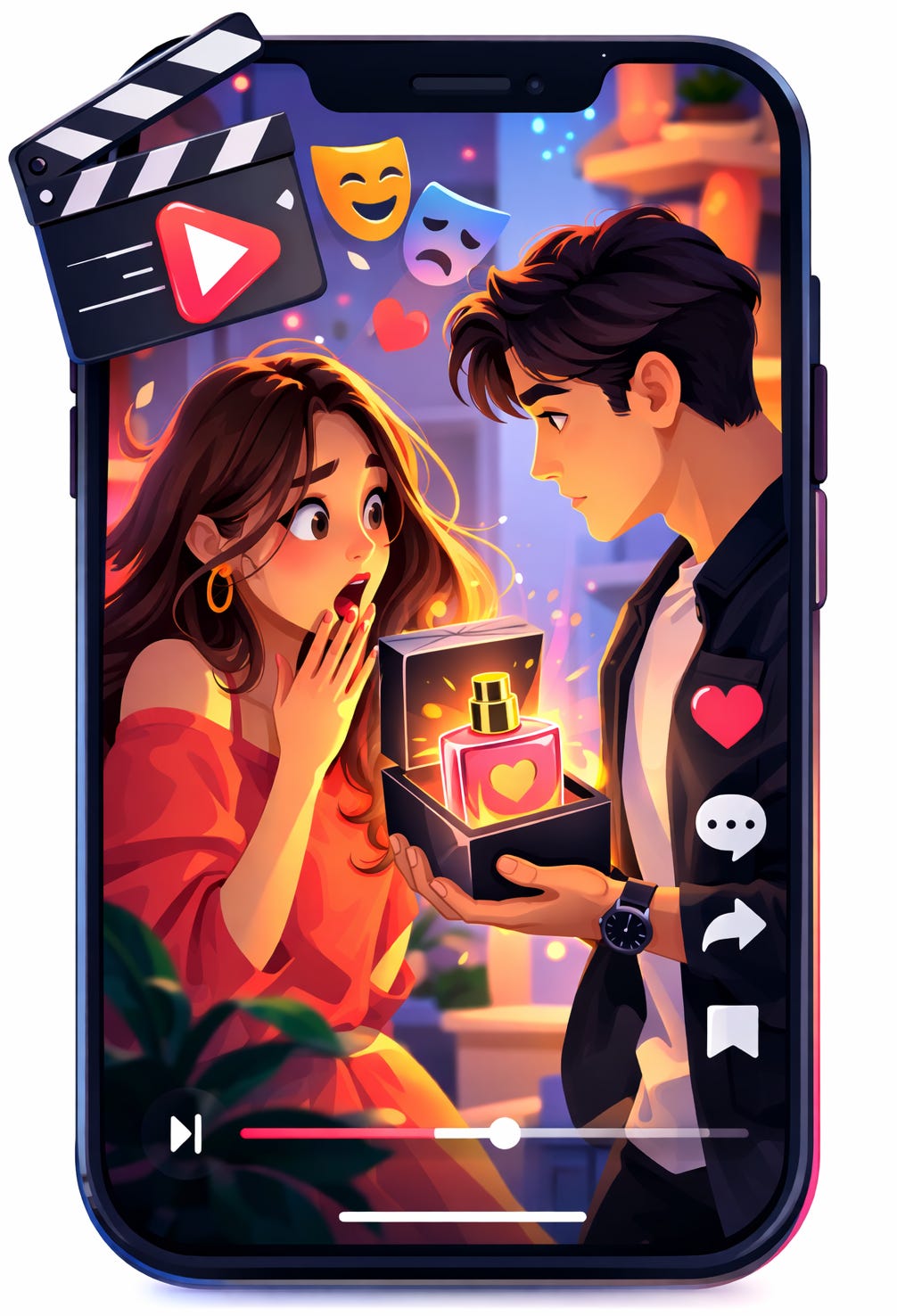
A microdrama is a short, serialized, mobile-first video story—usually in vertical format and typically 1–5 minutes per episode—built around strong hooks, narrative tension, and cliffhangers to keep viewers watching the next episode.
You’ve likely seen a ton of standalone narrative clips on TikTok and IG.
From silly action-reaction pranks, AI-generated young-turning-old celebs, to various recipe/app/cosmetics how tos - they all follow a clear story structure.
Set up> conflict > resolution.
Microdrama takes this further.
It tightly stitches those vignettes together into a clear, bite-sized, episodic structure.
Brand storytelling is of course, not new, but microdrama gives people a taste for more, leveraging proven storytelling techniques using:
Hook in first 3–5 seconds
Cliffhanger ending
Episodes 30–90 seconds
Product embedded into plot
Microdrama Examples
Maybelline — “Maybe This Christmas”
Format: 5-episode vertical rom-com mystery micro-drama.
Story: Two neighbors develop a romance while a mystery unfolds around the protagonist.
Product integration: Instant Eraser Concealer is part of the plot.
Crocs — “Charmed to Meet You”
https://youtube.com/shorts/vJhx1JahuBs?si=QLPhj6jeJKBnI2Th
Format: episodic video shorts.
Story: Crocs employee story.
Product integration: Crocs worn by the protagonists.
Starbucks — “ I Opened a Starbucks in Ancient Times”
https://youtube.com/shorts/DRHtY6kbfVo?si=UXRGVI42xNsRh7A9
Format: episodic video shorts.
Story: A modern barista introduces coffee culture to an ancient court. Good use of the Unlikely Combination principle.
Product integration: brand logo is clearly visible and characters directly use the product.
Other brands that launched microdramas include, Apple, Wallmart, KFC, Nike and many more.
Maybeline was one of the first brands last year, that used microdrama generating ~2M views per episode on YouTube with a total of 10M+ for the entire series.
Microdrama is no doubt a solid use of social video, that goes beyond the bland paid sponsored videos that break the experience for users.
On first look, they seem like any user-generated content you may find on your feed. From this perspective, you can think of it as applying a product placement logic into a social video platform.
The big difference from classic product placement, is that brands have a full control of the entire process; scripting, shooting and distributing.
This translates into these core benefits:
High entertainment value that reduces salesy content skip
You get to see the product in context - showing vs. telling
Addictive emotional arc keeps people coming back
Because it’s so easy to create these clips, I bet the next step would be to create a user-generated-content play where customers create their own branded microdramas for a chance to win prizes.
Scratch that! It’s already happened!
Good example, is e.l.f. Cosmetics ran a UGC “BeautyScape” TikTok Creator Series. Makeup creators competed in a TikTok reality-style series.
The prize: The winning creators co-designed a product palette. The palette generated 100k+ waitlist signups before launch.
Have a great story to tell and just need help with the latest tools
Book a call!
Looking ahead
The larger message here is that “old habits die hard” - we stick to what’s been working in the past, but adapting it to today’s platforms.
No news here, it’s part of our survival instinct toolkit.
Having said that, my guess this could be the last chapter of traditional marketing play. If and when AI agents are adopted by mainstream consumers, we’ll likely enter an agent-to-agent communication age.
Agents will work as gatekeepers for their owners, so to persuade your agent to buy my widget will likely require a whole different code-like “song & dance.”
What’s sure we’ll go through an initial hybrid period where you’ll have both persuasion forms active.
In fact, early adopters have already automated their key workflows today. However because agent configuration is still not super easy for the masses, you don’t have a significant reach that will modify brands’ strategies.
Thoughts?
See you next time!
Best,
- Shlomi
Shlomi Ron
Founder, Visual Storytelling Institute
story > visual > emotion > experience
shlomi@visualstorytell.com
P.S. Loved this story? Take your visual storytelling skills to the next level by upgrading to a paid subscription as a Narrative Partner.
You’ll get:
The “Top 10 Business Storytelling Formulas” eBook—practical frameworks to craft marketing that captivates and converts.
Exclusive content + bi-weekly Sunday insights to sharpen your narrative thinking, decode trends, and apply visual storytelling with confidence.
Full archive access for endless inspiration, fresh ideas, and proven techniques—ready whenever creativity strikes.