What If Learning a Language Felt Like Following a Story?
My Spanish-learning journey

Hi friend,
It’s great to see you!
Hope you had a nice week. What’s new in your world?
If you recall, I recently celebrated 10 years living in Miami. Quite a significant chunk of time, yet only two years ago, I felt it was time to start learning Spanish.
It will make things much smoother.
You see, I’ve always had a passion for languages. I strongly believe that in this day and age, sometimes you need to venture out and see the world through different cultural lenses.
That’s why for years, just for fun, I took Italian language classes. Over time, they became part of my Saturday routine.
Later, advanced classes piqued my interest in classic Italian cinema, and through that appreciating the magic of visual storytelling.
Fast forward to the present.
With 66% of the Miami-Dade population (1.8 million people!) speaking Spanish, representing a whopping 20 nations, it sure feels like you’re practically living overseas.
Spanish is spoken everywhere you go: in restaurants, grocery stores, service professionals, and more.
So, you can easily say the immersion aspect is already built in.
Initially, I took an online class from the University of Miami. It was fun, as it forced me to come up with answers with no aids after the teacher quizzed me. I also learned from other students’ responses.
The other approach was using Duolingo, which I’m sure you’ve tried, too.
It’s great, I love the entertaining visual storytelling approach, but the fact that you always have the full answers to choose from makes it too easy.
Not to mention the endless levels you have to go through.
One day, while having a haircut, my barber was gingerly speaking and laughing with her colleagues - in Spanish, of course.
I couldn’t help myself and asked her, “What is the fastest way to pick up Spanish?”
She laughed and said, “ Watch Spanish telenovelas, but with the Spanish subtitles on. This is how I learned English with English TV shows when I first got here.”
I took her advice, and after searching for the best Spanish telenovela on Netflix, came across “La Reina Del Flow” (“The Queen of Flow”).

This Colombian hit show, with over 200 episodes per season, means a ton of phrase repetitions, tells the story of Reggaeton musicians and their winding roads to fame, paved with catchy songs along the way.
In essence, Spanish is hitting you both from the dialogs and songs.
Learning a new language by watching a telenovela is pretty much like how a baby learns to speak by using their eyes and ears.
Catch phrases by the same actors get cemented, and if you don’t get sentences word for word, the visuals of what’s happening on screen close the gaps.
Learning by watching means you don’t have to rely on memorizing intricate grammar rules; you let your “sponge brain” naturally absorb new words, as the plot is always simple to follow.

AI can polish your message. I help you make sure the story actually connects. I’ll review and give you my “human feedback” on one asset: your pitch deck, explainer video, infographic, landing page, LinkedIn profile, newsletter, campaign, or brand story.
Confused? Just visualize it!
Learning a new language means getting out of your comfort zone and sometimes struggling to figure out new words.
Things that for a native speaker are taken for granted, for a new learner like me were initially quite challenging to learn and master.
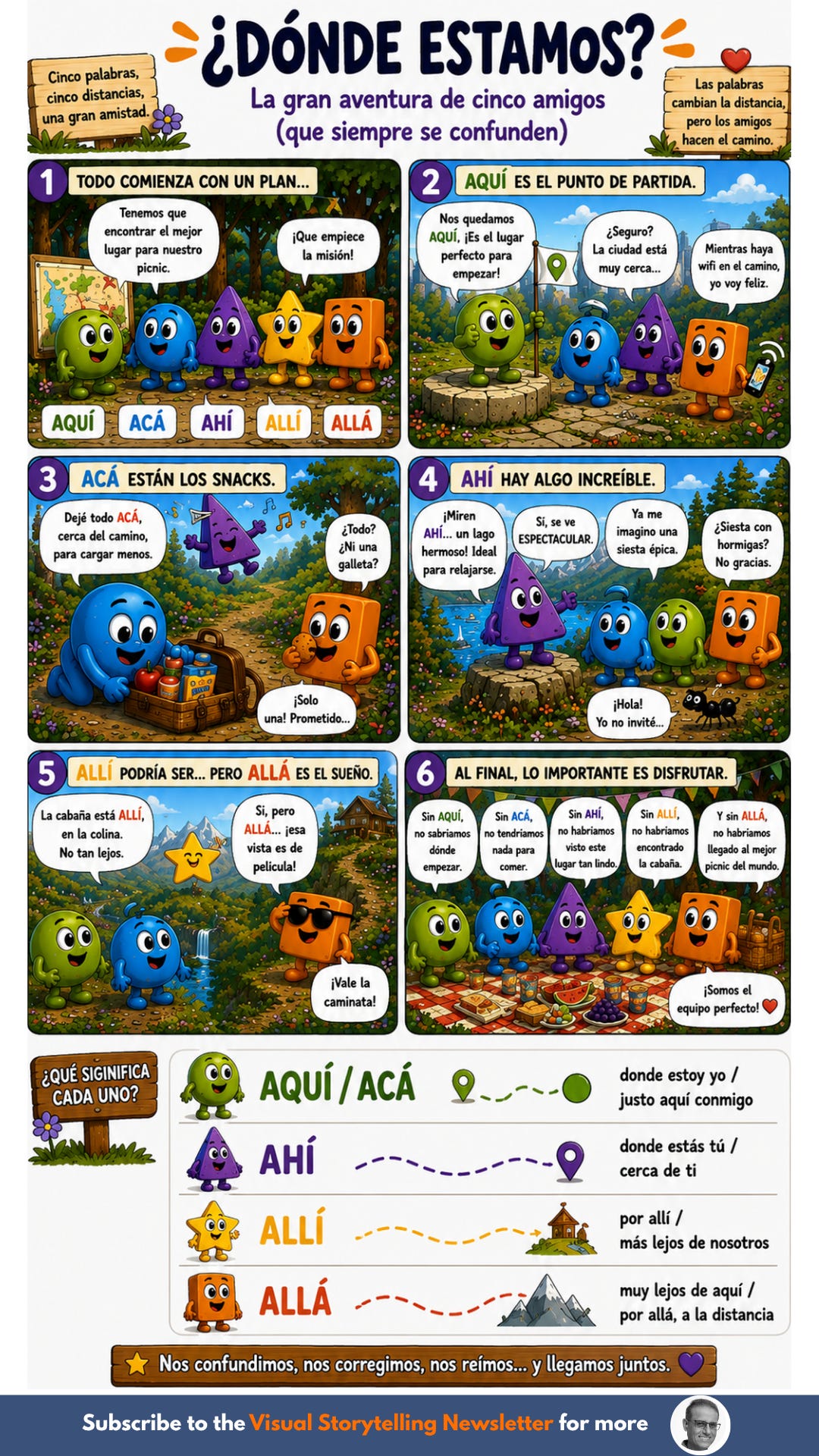
Here is a fun example that, with Chat’s help, I turned into a silly children's cartoon strip.
The story’s premise is simple: in Spanish, you have 5 different words for indicating location.
All of them sound very similar:
Aquí / Acá = right where I am
Ahí = where you are / nearby
Allí = over there
Allá = way over there
So, I figured, how fun it would be if I turned these 5 words into characters thrown into an adventure to help me clarify their meanings in context.
Here is what I came up with:
I’m still working on my Spanish, exchanging simple sentences with my gardener, and ordering the local signature ritual:
“Dos cortaditos sin azúcar, y dos empanadas de espinacas, por favor.”
“Two cortaditos without sugar, and two spinach empanadas, please.”

Zooming out
The big message here is that visual storytelling could be a fantastic vehicle for learning new languages, either by watching TV shows/movies in different languages or creating simple cartoons that can help bring to life nuanced meaning differences.
This is all part of the “edutainment” category - leveraging entertainment to teach new concepts.
Zooming out, you can apply storytelling to other corporate educational programs; your product’s How To tutorials, various annual employee training courses, new customer onboarding, and much more.
Speaking of learning a new language, you’re absolutely right: with AI these days, you can definitely have it transcribe your native language into any foreign one in real time.
But hey, by relying on AI, you’d be missing a big opportunity to flex your brain’s muscles. When you learn a new language, your brain gets stronger, and your neurons connect in new ways.
A recent landmark study from the MIT Media Lab, titled "Your Brain on ChatGPT: Accumulation of Cognitive Debt,” found that overreliance on AI can weaken functional connectivity in the brain and impair memory recall.
Broadly speaking, next time you’re instinctively rushing to your fave chatbot for a simple task, consider this: AI works like an ATM.
Every request you make is nothing but a withdrawal from your brain capacity balance.
So keep your neurons active as soccer players fiercely practicing for the World Cup semi-finals - forging fresh new neural connections.
Trading speed for more ownership, you’d also be more satisfied with the work you put in.
How are you picking up new languages? Feel free to drop your adventures below. Always looking for new shortcuts :)
See you next time!
Best,
- Shlomi
Shlomi Ron
Founder, Visual Storytelling Institute
shlomi@visualstorytell.com | Follow me on Notes
story > visual > emotion > experience