Hi friend,
How are you? Hope you’re doing well.
The other day, I was invited to an Ask Me Anything session about storytelling and marketing for a group of entrepreneurs.
It was a lively session with fantastic questions that people truly grappled with.
One of the questions that popped up was how to get the most out of networking events.
I figured this is a topic I could expand on here, as we all go to so many events, and it’s important to go with a clear strategy in mind.
Quick heads up, everything I’ll share is coming not from published studies but right from the trenches of my personal experiences and real-life observations.
Your experience could be different, and that’s great.
Feel free to comment, so we get to see what you see.

What is a networking event?
In simplest terms, it’s a business event that could take place offline or online, where people who don’t know each other meet to explore potential business opportunities.
Business opportunities could range from finding a job, a new client, an investor, a potential partner, a co-founder, or even a developer for your new AI widget.
So, consider what your goals for attending are.
Today I’ll focus more on offline networking events.
Networking event types
Standalone: These are events that have no specific agenda or speaker. It’s all about mingling with new people and exchanging perspectives and contact info. These types of events tend to be in fun locations, such as coffee shops, restaurants, boats, or fancy hotels. This is how you achieve the full work & play vibes.
Appetizer & Dessert: Here you have a main event, with bold-name speakers or a panel around a hot topic - the magnet - flanked by a networking session before and after. This allows attendees to first meet and greet, and after the main event, interact with the speakers and themselves.
Note: Even if you’re planning just a pre-networking session, by default, you’ll have a lingering effect of people hanging out after the main event to continue networking.
Where to find networking events?
You can run an AI or Google search for events in your area using keywords around your topic of interest.
Dedicated event websites like Meetup.com or luma.com can help, too.
Another source is colleagues and partners. Uninitiated, it typically pops up in a Zoom chat close to the end of the call: “Are you going to Ai4 next week? All the major AI players will be there.”
Join community or trade associations, sign up for conferences in your focus area - all these event types involve networking.
Complement your networking strategy with a proactive approach of starting your own networking event.
I, for example, started the Miami Storytellers Studio, a meetup luncheon event for local storytellers networking at Miami’s historical Biltmore Hotel.
It’s simple and easy to execute, and as a host, you build your network around you.

Pre-event prep
If you attend big conferences like eMerge or South by Southwest, you can minimize the random chance of meeting the right people by using the event app.
Create a compelling profile that succinctly captures why people should care.
Then head to the Attendees section and find relevant people by keyword search or company name. Contact them and ask for a meeting.
Some conferences give attendees some “I attend [conference name]” banners to announce their upcoming attendance on social.
Use them, for example, on LinkedIn:
“I’m attending eMerge 2026. DM if you want to meet up.”
During event
Social context
When you throw a bunch of people with varying degrees of familiarity in a room with some refreshments and drinks, you get various social interactions.
Those who know each other well or partially well, for obvious reasons, will experience the easiest way to connect.
After all, they already carry some shared experiences, so a networking event is just an opportunity to catch up.
The big promise lies with the strangers. These people are like that “box of chocolate, you never know what you’re going to get.”
The unexpected and surprising element is what makes this social interaction, in my opinion, so engaging.
Yep! That element of serendipity :)
Personality types
In networking events, you’ll likely find two types of personalities:
Introverts: This category of people tends to struggle with proactively starting new conversations with strangers. How do I start? What should I say? Instead, they prefer getting approached if they attend at all.
Extroverts: highly social people who can naturally strike up a conversation with anyone around them, and even barge into an existing conversation between two people.
Another important variable is the popularity level.
Regardless of your personality type, if you have an established level of fame, people will flock to you.
You can easily recognize these celebs; they typically tend to have a “moat of people” around them, chatting with close friends while the others are waiting to squeeze in a few words.
Or they’re stuck in a long 1:1 conversation with someone else, and no force in the world can break that deep chat.
You later realize they were the host and the invited panelist…
Timing: If you arrive early to the event, you’ll catch two factors that work in your favor: not a lot of people around, so you’ll likely get approached, and find it easier to start conversations, as people’s curiosity and energy are still running high.
Stay tuned for upcoming episodes of my new micro-drama HUSHWAVE on my Notes feed
It’s a story about Marea Labs - a fictional Miami startup
building an AI sound-cancellation product called HUSHWAVE.
It can quiet motorbikes.
It can quiet car bass.
It can quiet leaf blowers.
without any wearable device
But the team runs into a harder question:
What should the technology refuse to erase?
A few lines of story.
One cinematic image.
And the video plays in your head.

Follow along: https://newsletter.visualstorytell.com/notes
How do you strike up a conversation?
Forget about storytelling or elevator pitch, the initial challenge - especially for introverts - is how even to break the ice and start a conversation with a stranger.
From my experience, I’ve come across several tactics that work:
Peripheral cues: Pay attention to interesting visual signals you notice to kick off a conversation.
It could be a name badge with a company name that’s been on the news, or an interesting job title you can ask: “So how does a typical day look like for a Head of AI Strategy?” Reverse-engineering: to attract people to you, consider leveraging your badge name real estate to plant curiosity triggers: “Ask me what I wish I knew 5 years ago.” Or "30% of your tech budget is wasted. Let’s talk.”
A familiar face: “You look so familiar? Have we already met somewhere? Did you attend eMerge last week?” Cheesy, but hey, we’re looking for the common denominators here, right?
An interesting outfit: “I like how your crimson red and purple nicely mix!”
A tasty snack the other party is munching on: “These spinach empanadas are so good, right?”
Location: In a very noisy, crowded networking space at the midpoint of the event, look for people standing alone in a quiet spot. It could be a quiet corner or a terrace. Approach them with “You definitely found the perfect place to break away from the noise” and apply the double strike: extending your hand for a handshake, supported by “Nice to meet you…”
The long gaze: Simple but effective. You see, there are two states people are in during networking: Deep in conversation with someone or between conversations.
The latter means they’re free to start their next chat.
Start by scanning your immediate radius. Spot another person 3 steps away from you who is also between chats. He/she may also be looking around or messing with their phones to look busy ;) If you apply a long gaze, say 7 seconds, he/she will often acknowledge you.
This is your signal to activate the above “double strike.”
What do you say?
“Crossing the chasm” of the first touch, you now have the other party's full attention. This is where your storytelling skills come into play.
Before touching on various Elevator Pitch tactics, this brief social interaction has 3 parts:
Attention grabber per above, followed by small talk.
The WDYD meat: Your best bet is first to ask the other party the $1m question:
What do you do? The reason being this will enable you to frame your story around their interests, rather than shooting in the dark. This part is the most important because here a good match could expand the conversation further.The break: It’s essential to know when to break off a chat after covering all bases and exchanging contact information (physical business cards, or LinkedIn’s QR scans). After all, like in Speed Dating, your goal is to meet more people.
When it’s your turn to answer the “What do you do? question, first know that there are many formulas you can choose from.
From this perspective, networking events are nothing but free “gyms” or “focus groups” for practicing your pitch, gauging response, trying out new formulas - to sharpen as well as customize your story to buyer personas (decision maker vs. influencer).
Regardless of the storytelling model, your answer needs to address:
1. What you do: Simple and concrete.
2. Who it’s for: Signals relevance quickly.
3. Why it matters: The high stakes and the outcomes you achieved.
4. Optional curiosity hook: Something memorable that invites questions.
For example someone’s pitch could go:
“Did you know that fewer than 5% of startups seeking seed funding actually get funded? I help early-stage founders turn messy ideas into investor-ready stories. Clients have raised $25M+ with sharper pitches—because in fundraising, clarity isn’t polish; it’s survival.”
Keep it short, up to 30-seconds one liner that is designed to trigger curiosity.
You know you passed the first test if you receive “Interesting! Tell me more!
Other effective formulas include:
Glaring Question
Problem — Present a problem as a question
Agitate — Agitate the problem
Solve — Solve the problem
Customer Story
Incident — Share a relevant customer experience
Action — Describe the specific action taken to solve or prevent a problem
Benefit — State the benefits/results of the action
The second test is if both parties identify a common opportunity and agree to exchange contact info.
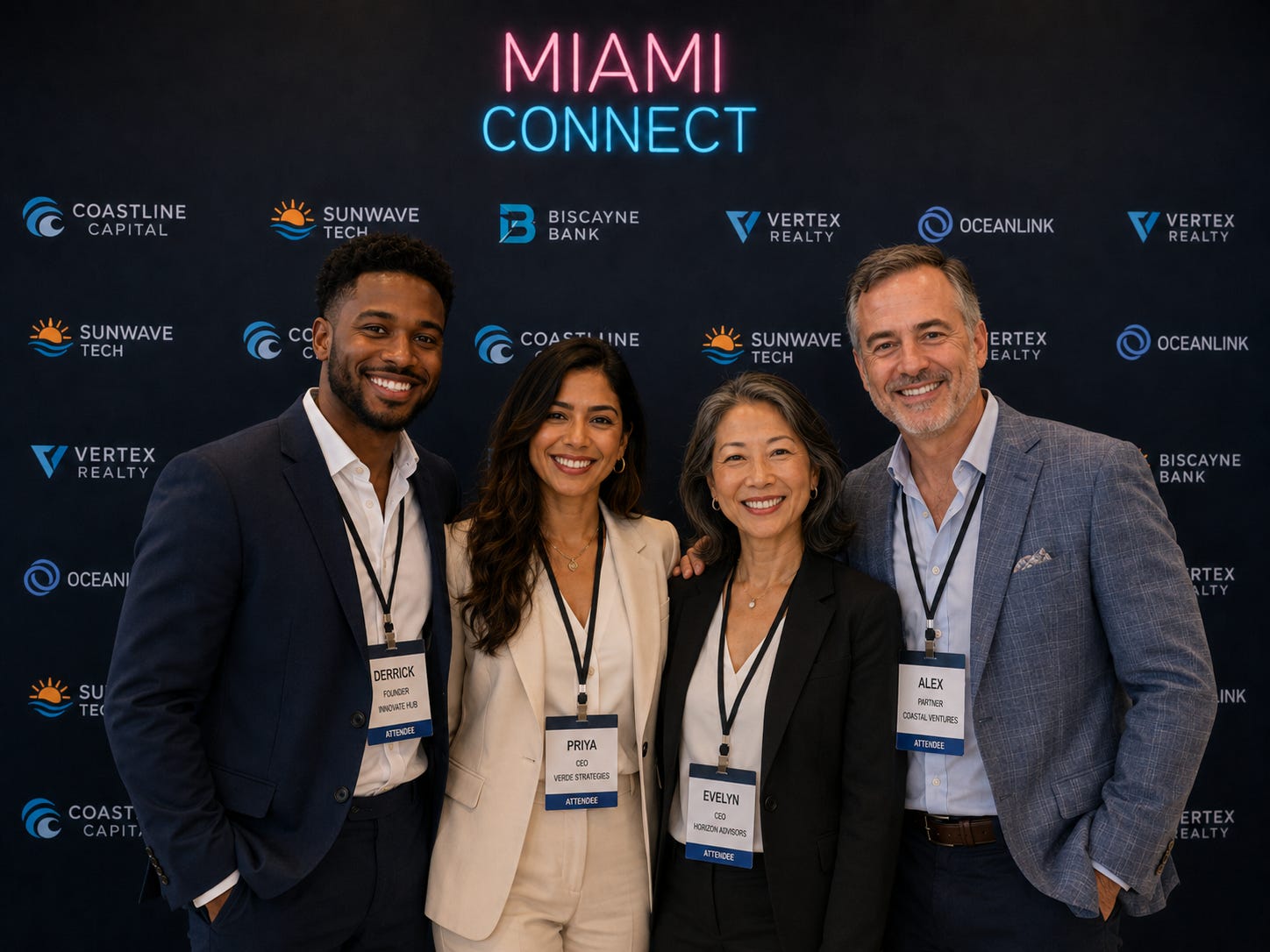
For those successful encounters, don’t forget to take photos with new contacts, smiling faces against a memorable context like a booth, beach backdrop, or the conference media wall.
Post-event
Share your experience
Photos with faces engage the most on social. They’re authentic and drive emotional reactions. So, post-event leverage that and publish a LinkedIn post with an insightful recap that shows value for those who didn’t attend.
Recent personal experience I shared:

Another classic visual angle you can include:
Hidden truth
Realize that networking events work like dating. That means, onsite excitement does not always translate into connection afterwards.
A true story!
You can spend 30 minutes chatting with someone you feel you hit the jackpot with.
He/she loved what you do, you identified opportunities to work together, you exchanged contact info (2nd test), and even shot a few text messages to check you’re truly connected.
However…
A few days after the event, you follow up once, twice, or even three times, and you get nothing but crickets. Dead silence!
Don’t fret, it’s normal.
The reason is simple.
People you meet in person are nicer and more supportive because you’re all in a party feel, and there is no place to hide.
True, sometimes there are external reasons that could explain the silence, other times it’s just not a priority or plain disinterest.
Having said that, some of my great contacts came from networking events.
Show me the money!
The post-event time is where the final test kicks in. This magic happens when you convert a 10-minute chat into a real paying business opportunity.
It all boils down to mutual interests, chemistry, and follow-through.
Know someone who would benefit from reading this?
See you next time!
Best,
- Shlomi
Shlomi Ron
Founder, Visual Storytelling Institute
shlomi@visualstorytell.com | Follow me on Notes
story > visual > emotion > experience